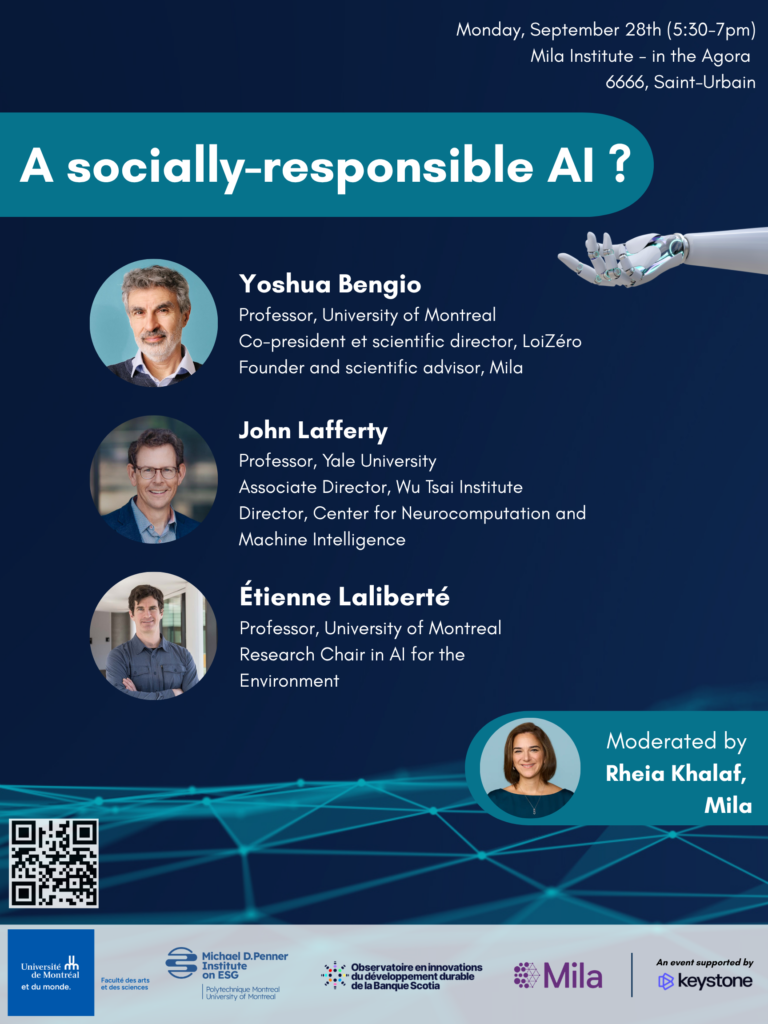
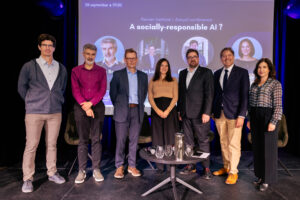
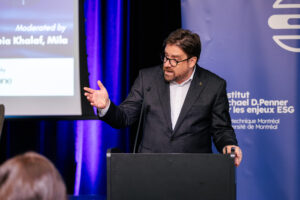
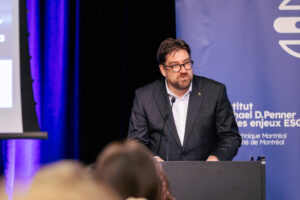
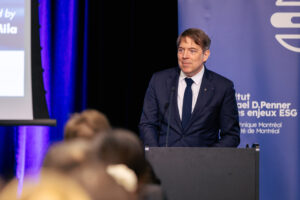
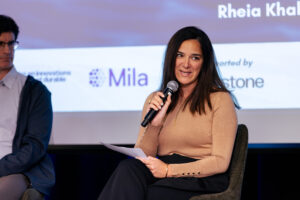
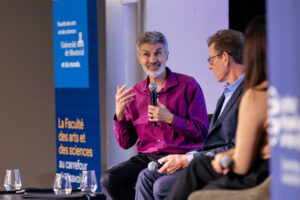
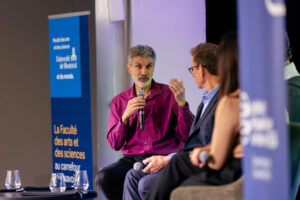
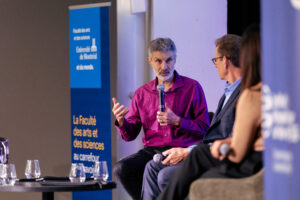
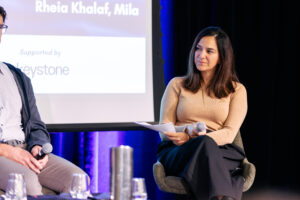
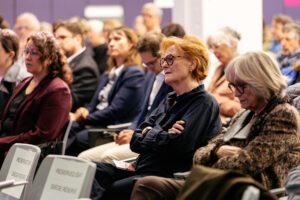
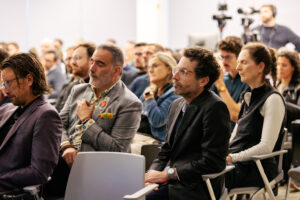
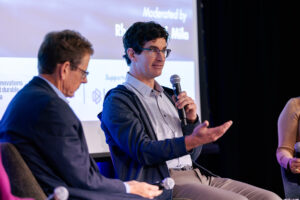
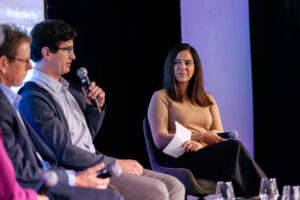
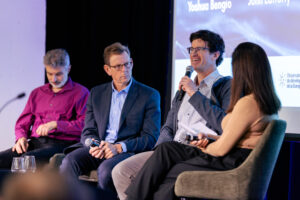
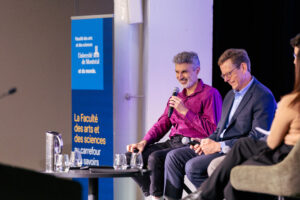
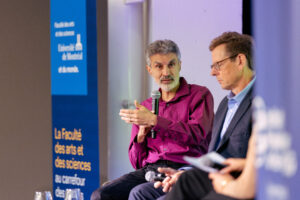
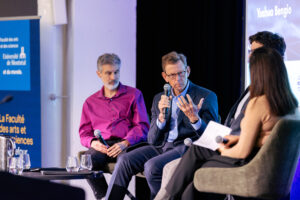
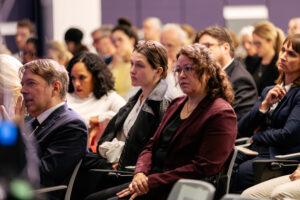
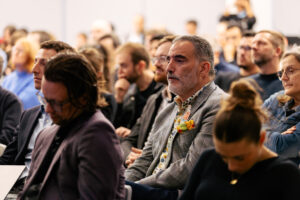
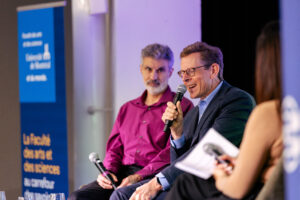
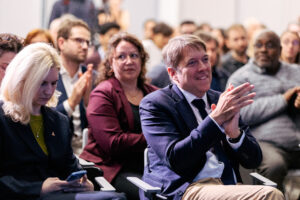
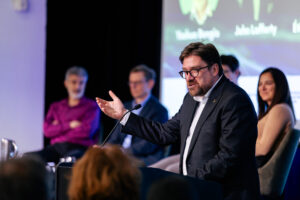
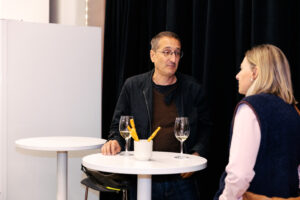
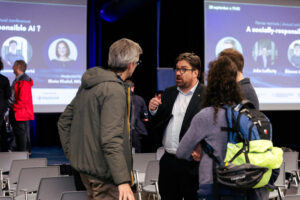
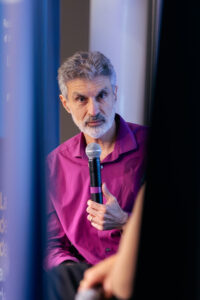
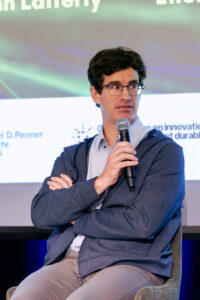
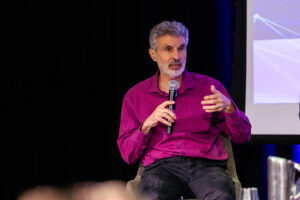
On September 28, 2026, more than 160 people attended our annual conference, “A Socially-Responsible AI?” The discussion focused on AI governance and the ethical implications of AI development around the world, featuring three renowned speakers: Yoshua Bengio, John Lafferty, and Étienne Laliberté. The panel was moderated in English by Rheia Khalaf.
Environmental, social, and governance (ESG) considerations have gained prominence within organizations over the past two decades. Consequently, the development and use of AI by companies raise a multitude of ESG and ethical questions: privacy protection, intellectual property, bias, impacts on the labor market, GHG emissions and resource consumption, energy costs, the construction of data centers within local communities, and more. But how can organizations leverage AI to fulfill their social responsibilities? Is its development socially responsible? And what is its potential for social progress and environmental protection?

_______________________________________________
Location : 6650 Saint-Urbain street, at Mila (Agora room)
Date and time : September 28, from 5:30 p.m. to 7:00 p.m.
_______________________________________________
Watch our recording on Youtube!
About our Speakers :
Yosha Bengio is a professor at the University of Montreal, scientific director of LoiZéro, founder and scientific advisor to Mila—the Quebec Institute for Artificial Intelligence, and holder of a CIFAR Chair in AI in Canada. He is recognized worldwide as one of the leading experts in AI. He is best known for his pioneering work in the field of deep learning, which earned him the 2018 A.M. Turing Award. In 2023, he was appointed to the United Nations Scientific Advisory Board, tasked with providing independent advice on scientific and technological advancements. Concerned about the social impact of AI, Yosha Bengio helped draft the Montreal Declaration on the Responsible Development of Artificial Intelligence and continues to raise public awareness about the importance of mitigating the potentially catastrophic risks associated with future AI systems.
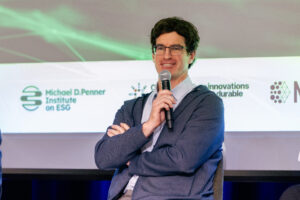
John Lafferty holds the John C. Malone Chair in Statistics and Data Science at Yale University. He also serves as associate director of the Wu Tsai Institute at Yale and director of its Center for Neuroinformatics and Artificial Intelligence. Professor Lafferty is a pioneer in the fields of machine learning, linguistic models, and the statistical foundations of artificial intelligence. His fundamental research on conditional random fields, topic models, and graph-based learning has been recognized multiple times with the “Test of Time” Award. He also helped establish the first doctoral program in machine learning in the United States at Carnegie Mellon University and has held positions at the University of Chicago, Carnegie Mellon, Harvard, and IBM’s Thomas J. Watson Research Center, where he worked on natural language processing, linguistic modeling, and speech recognition. As a member of Yale’s AI Steering Committee, Professor Lafferty brings in-depth technical, applied, and institutional expertise to issues related to the responsible governance of AI.
Étienne Laliberté is a professor in the Department of Biological Sciences at the University of Montreal, a member of the Institute for Research in Plant Biology (IRBV), and holder of the Canada Research Chair in Artificial Intelligence for the Environment. Étienne Laliberté’s current research focuses on developing new approaches to vegetation monitoring (plant biodiversity and carbon) based on high-resolution remote sensing using drones and computer vision. He is particularly interested in applications of this technology that can help mitigate biodiversity loss and climate change and that can have a rapid, large-scale impact.